Tuesday, May 17, 2011

“News near you” on Google News for mobile

Google News for mobile devices has added a “news near you” section that displays headlines related your device’s current location.
Its ease of use is impressive — just grant the site access to your device’s current location and it pulls up local headlines. While it goes further than any other mobile news aggregation site, it has flaws that leave room for another company or news organization to do better.
The “News near you” section on Google News for mobile.
More on that later, but first the key context on this feature and what Google is up to.
Google executive Eric Schmidt declared at the start of this year that the search giant would be all about preparing for the “mobile revolution.” All of its 2011 strategic initiatives focus on mobile, he said. “Between the geolocation capability of the phone and the power of the phone’s browser platform, it is possible to deliver personalized information about where you are, what you could do there right now, and so forth — and to deliver such a service at scale,” Schmidt wrote in the Harvard Business Review. Google is making mobile its first focus on all products.
Google News has had a local section on its website since 2008, but this new addition to the mobile version has precise location targeting. The desktop site places me in the Washington metro area, and shows me headlines from all over D.C., Maryland and Virginia. The mobile site detects my location specifically (and correctly) in Arlington, Va., and serves only very local news and features.
Now for the flaws, which leave room for a competitor to elbow into this mobile/local aggregation market.
First, the sources I see in my local feed from Google are not so diverse. Most of my headlines are from The Washington Post; a couple come from the Arlington Sun Gazette community newspaper. Google does, however, show me a couple posts from an active local news blog, ARLnow.com. There is room for either Google or a competitor to make a more comprehensive product.
The bigger problem for Google is that location is only one piece of the quest for the holy grail of online news: relevancy. So far, Google News is doing a good job of determining my location and aggregating stories that mention that location. But that’s where it ends, and that’s not good enough. What’s missing is the curation after the aggregation.
Two of the top five “local” stories Google News served me were either not really local or not really a story.
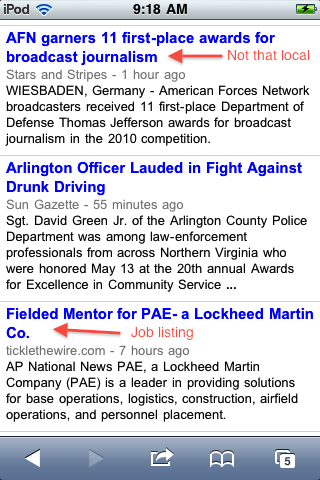
For example, the third story Google News showed me this morning was about the Armed Forces Network receiving broadcast journalism awards. A few of the award winners are here in Arlington, so it is a legitimately local story, but it’s not very relevant to me and certainly not among the top three things I want to read about my community today. The fifth headline in my Google News feed was a job listing for Lockheed Martin (based in Arlington, yes, but not news).
To create a market-dominating filter of local news, someone will need to curate the pool of aggregated news to match each reader’s interests, browsing history and social network activity, in addition to his or her location.
The killer app would be one that filters a breadth of local aggregation like Outside.in through a hyperpersonalized social filter sought by mobile services such as News.me and Trove combined with the personal browsing and search history of Google.
And even with all that, it remains to be seen whether automated filtering can entirely replace the role of a human editor in subjective news judgment. A human news editor would know a job posting is not a local news story no matter how many times it mentions your city’s name.
There remains an opportunity for media companies to be the dominant source of news aggregation and curation in their local markets, if they leverage their human touch and institutional knowledge as an advantage over Google and catch up on some of the technological systems. But many news organizations will first have to conquer reflexive fears about linking out and sending readers to other sites.
Your opinions are welcome here. Can a news organization curate better than Google’s engineering-based system? Will Google’s algorithms eventually be better than a human editor? Or will both approaches co-exist?   source

3G Hiccups

Walk into any mobile service provider's showroom and what you will see are the letters 3G everywhere. You will also be invited to see demos of ‘blazing' speeds. It is only when you go for a 3G connection that you start wondering whether you are just a guinea pig for the service provider.
Many of those who went for 3G services during the demo period got the advertised speeds. Only when the services went paid did the problems start.
One customer who suddenly found the speed drop to 30 kbps from over 3 Mbps was told to ‘enable 3G' again by sending an SMS ‘3G'. When he sent the SMS, he got the reply ‘3G services already enabled'. When he tried to recharge his account with a 3G pack, he was informed that the 2G Internet services were already on, and that he would have to disable it. He was told to send a ‘stop' request, which he promptly did and got a reply that the Internet services had been stopped. When he tried to recharge again, he got the message that the 3G pack could not be activated as he had over 2000 MB of data left in his account. To get the 3G services, he had to bring the unused data to below 50 MB. The ‘helpful' customer care lady asked him to keep downloading continuously so that the data came down below 50 MB. It would take weeks, the customer pleaded. There is no other alternative, was the reply from the customer care. The customer got fed up, threw away his card and got a new 3G enabled connection.
Another customer (with another operator) who got only 2G speeds was billed for 3G services. The 3G connectivity was also scrappy. The call centre was clueless about what she was being billed — for 3G or 2G. She got fed up and went back to 2G; at least the speed was consistent. When she tried to deactivate 3G, she got a message that 3G services were not active in her number. A call to the customer service department confirmed that 3G services were in fact, active.
Another operator attracts customers by advertising speeds of 7.2 MBPS. When a potential customer wanted to test the speed at the operator's demo zone, he was informed that the services were still not ‘stable' and that he would get speeds of only around 3 MBPS. The speed test revealed the real speed — it never crossed 2.2 MBPS!
This is the case with CDMA operators too. One operator who advertises 3G speeds in its USB modem had this excuse when the customer complained he was getting only around 1 MBPS against the advertised 3.1 MBPS. The customer service was surprised. “What? You get 1 MBPS? If you get speeds above 500 kbps, according to us, you are getting above average speeds.”
So, if you are ‘excited' about 3G, it's better to wait till the operators get a hang of their services! source

InMobi’s new mobile payments service to reach three billion users

By James Ratemo
InMobi, the world's largest independent mobile ad network, announced the launch of InMobi SmartPay™, a performance based global mobile payments solution.
InMobi SmartPay™ will enable app developers, game companies, and content providers in the US $200bn mobile content and virtual goods space to expand their business and monetize their users quickly and easily into new markets by providing a one-time, no-cost, single point of integration across multiple countries.
The solution offers consumers a seamless, pure mobile checkout experience using secure, direct to carrier billing to start, but expanding to all forms of mobile payment methods including credit cards, PayPal, and local mobile wallets by the end of 2011.
†The new solution already offers reach to over one billion consumers in seven countries, including the US, UK, Germany, India, Indonesia, South Africa, and Malaysia, with huge growth plans to expand to over three billion consumers in 30 countries by the end of the year.
"Our mission is to connect businesses and developers to consumers around the world with innovative, best of breed mobile technology and services. InMobi SmartPay™ will help us with that journey and our evolution as a company to be a key technology enabler within the global mobile ecosystem, especially for the developer community," said Naveen Tewari, CEO of InMobi,
"Expanding to new markets is an extremely complex process today, especially for small developer teams sitting in a single geography. InMobi SmartPay™ exists to simplify the process through a single point of integration and management of all tax, legal, and customer support issues leveraging our in-market expertise. Even more importantly, we are an intelligent solution providing consumers with a low friction, secure purchase flow, and data-driven insights to help maximize conversion," said Piyush Shah, Vice President of InMobi SmartPay,
InMobi SmartPay™ is already active with numerous clients globally and is moving into private beta over the next 60 to 90 days before opening up the service to the entire market in Q3, 2011.
The launch of InMobi SmartPay™ is the first global offering of its kind in the mobile advertising market. It combines InMobi’s massive global ad network of nearly 32 billion ads monthly in 200 countries with a mobile payments solution, enhancing its core competitive advantage for clients by integrating actual purchasing behavior into its real-time ad-serving feedback loop. Tracking from ad to conversion is a major leap forward for developers and digital goods providers globally.
Major competitive advantages of the service include its ability to monetize three billion mobile consumers in 30 countries easily through mobile web and Android in-app billing by the end of 2011.
With the service also comes analytics tools that offer transaction performance insights that help clients maximize conversion in every country.
Apart from integration with the InMobi ad network providing post click performance optimization from ad impression to purchase. It also comes with secure and efficient technology that handles regulatory fraud, tax, currency, and settlements across all countries. source

Tablets in DEMAND

Last year, when Dow Jones tied up with Bharti Airtel to feature financial and business news from Wall Street Journal and its own wire services on mobile devices in India, the MD of Dow Jones India, Mitya New, showcased the content on the Apple iPad and Samsung Galaxy Tab. This was surely indicative of things to come.The tablet PC is emerging as a must-have among the tech-savvy in India. However, tablet users in India till very recently had very little choice - they could either buy an Apple iPad or the Android-driven Samsung Galaxy Tab. There is the Olive tablet too since October last year, but apart from its pricing, it has failed to create an impact.
Last week, the tablet options doubled with the launch of Acer India's Iconia Tab A500, an Andriod-based 10.1-inch gadget, and the Windows 7-based Iconic Tab W500 in the same size. The A500 works on Google's Android Honeycomb 3.0 platform, the first tablet with Honeycomb 3.0 in India.


Several players are just waiting in the wings to launch their own tablets. "We can expect multiple launches in July-August so that the tablets are on the shelves by September. Lenovo's LePad, BlackBerry's Playbook, HP's Palm tablet and Cisco CIUS are expected to hit India in the coming months," said Sumanta Mukherjee, lead analyst for PC products, Cybermedia Research.
Samsung has announced two more tablets and Acer has lined up a dual touchscreen notebook for later this year.
There are no official figures for the number of tablet users in India as it is a very nascent market. However, the current market leader is the iPad, according to market watchers, despite its late official launch in India in March 2010. According to sources, iPad2 shipped 20,000 pieces for its India launch on April 29, which sold out within 72 hours. The current waiting period for an iPad2 is about 21 days.
There is the likelihood of local Indian mobile phone makers such as Micromax coming out with their own tablet soon. Also, there is talk of Reliance Infotel, which has bagged a 3G licence, coming up with its own branded tablet, Mukherjee added.
The market is niche and only a small percentage of Indians are likely to buy a tablet if they already have a mobile phone and a laptop or PC, said Rajiv Makhni, managing editor (technology), NDTV. "The tablet market will get very interesting the minute a company has the foresight to launch a tablet priced under Rs 15,000. If that happens, it will penetrate the masses and the tablet will become the new all-in-one entertainment and communication station."
Sandip Biswas, director, Deloitte Touche Tohmatsu, said, "We should not be surprised if, in two years' time, Android-based tablets priced below Rs 10,000 emerge. Anyway, the tablets will need to come below Rs 20,000 in order to address larger consumer numbers. People are already working on that in the Far East and Asian markets."
Tablet-makers are optimistic. "Across India, the response for the Tab has been huge and Samsung is already targeting a 50% share of the Indian tablet market this year," said Ranjit Yadav, Samsung's country head for mobile and IT.
"With consumers getting more technologically aware and willing to experiment with new gadgets, we are confident that tablet PCs will capture a significant share in the market, which will focus on early adopters and tech-savvy users who want to experience more content on the move," said S. Rajendran, chief marketing office, Acer India.
"Tablets are aimed at a new and emerging consumer demand that is poised to grow phenomenally. Consumers have already started to explore the tablet's limitless potential," said Vishal Dhupar, MD, Asia South, NVIDIA, a computing technologies firm that has partnered with Motorola, Samsung, Acer, LG and Asus for their tablets.
"As our professional and personal lives get more intertwined, consumers will increasingly look for a device that can cater to both professional and leisure needs. With the growing availability of high-speed mobile and wi-fi networks, mobile devices will also be used for performance-intensive tasks handled so far by traditional PCs."

"We believe that tablets will end up being an awesome content consumption device as people have mobile lives and expect to see and share content in real time. An improving global economic situation is likely t find customer spends increasing on aspirational products. With more useful and interactive content, the demand for handheld devices has already started to pick up. Tablets have started to find usages inside corporates, hotels, education and healthcare. This will further consolidate the tablet's position as a specific category and not as a replacement to netbook or a notebook," said Jagdeep Kochar, VP & business head, EBS Worldwide.
Deloitte's Biswas said, "Enterprise usage - medical representatives, sales and retail service personnel are all potential users of tablets. Even payments on delivery can be effected on tablets."
In terms of relative usage, Biswas said, "People will continue to use mobile phones for its primary voice utility; the tablet will become the mobile PC device and laptops/notebooks will sit on table tops in offices or homes. The desktop PC's days are over."
By March 2013, Deloitte expects that worldwide, 35% of the overall tablet PC base of around 100 million units will be delivered by iPhones, 40% by Android-based tablets, 15% by Windows-based tablets and the remaining by other technologie. source

Monday, May 9, 2011

VRock Gets Interim Order Against RCOM For IPL4 VAS

Hot News is hot again: VRock mobile has obtained an interim order from the Delhi High Court, which restricts the provisioning of SMS and Interactive Voice Response (IVR; voice portal) services being provided by Reliance Communications to customers, for the Indian Premier League (IPL). The order was obtained ex-parte; Justice V. K. Jain, upon hearing arguments from the plaintiff (vRock) said that an interim permission will be granted to Reliance Communications, subject to making a provisional payment of 25% of revenue earned so far by providing value added services related to IPL 4, and continuing to pay 25% of revenue earned, and subject to the same terms and conditions since vRock has agreed upon with Tata Indicom. If Reliance Communications doesn’t approach vRock for this deal, then there is an injunction preventing it from providing SMS and IVR services. Season four of the IPL is expected to end by May 28th, and the court took into account that the matter needs to be heard at the earliest. MediaNama was present at the hearing.
Explaining the concept of Hot News, Pravin Anand, representing vRock Mobile, pointed out that news such as Cricket scores is time sensitive, and while it is in outside the realm of copyright, it is a case of quasi-property; IPL has a limited timeframe. Additionally, he said that Reliance Communications (RCOM) cannot deny that the rights to Cricket scores via SMS and IVR exist, since it had itself entered into commercial negotiations with vRock for the very same rights for the ICC Cricket World Cup; talks had ended when an agreement over the amount to be paid to RCOM for the rights could not be reached. RCOM, as we had reported earlier, had acquired all mobile rights for the ICC Cricket World Cup. vRock also disclosed that it has paid Rs. 65 crore ($14.5 million) for a period of 5 years for the rights.
Please note that this is an interim order, issued ex-parte, which means that Reliance Communications was not represented.
Implications
One immediate implication of this is that RCOM will have to disclose revenue earned from providing these services to the court, if it does tie up vRock, else it will have to stop its SMS and IVR services. Secondly, the question of who owns the right to provide Cricket scores, even if for commercial purposes, lends itself to a larger debate of whether information of a public event is a case of quasi-property, and the organizer has ownership of this information. Remember that the owner of the event controls access to it. source

Apalya wins Global Mobile TV Rights for IPL 2011 and 2012

So it’s confirmed, albeit rather late, and almost a full month after we had reported it: Apalya, the mobile and broadband video streaming platform, which has the widest distribution with telecom operators in the country, has announced the acquisition of exclusive mobile and video streaming rights for all matches from the Indian Premier League, for two years including the current 2011 season. Apalya was also the Mobile TV partner for IPL’s 2009 & 10 season. Meanwhile, vRock Mobile was in court yesterday, trying to protect its IPL4 SMS and IVR rights.

Other companies delivering TV content over mobile include Percept Knorigin with BSNL, and Geodesic’s joint venture with the Zee group for Mundu TV. Also note that ZengaTV, which had acquired live streaming rights for the first season of the Indian Premier League, recently inked a mobile streaming partnership with (still) UTV owned Indiagames.

Apalya also recently tied up with Bharti Airtel for broadband services, delivering TV and video on demand content over wireline broadband at Rs 99 per month; not a net-neutral service. The company also had partnerships with Vodafone for the mobile broadcast of Cricket World Cup 2011, claims to have partnerships with more than 150 televison channels in India. source

Tuesday, April 26, 2011

Mobile video calls all set to catch-up in India

According to a new survey conducted by PwC, a consulting firm, the Mobile VAS market in India is set to grow to a Rs 55 thousand crore industry by 2015.

Thanks to the  BWA and 3G network roll outs. Speed that so long has been a deterrent for overall VAS adoption, will now be a key enabler that will drive adoption of VAS.
Here are some interesting results of the PwC report titled Value Added Service: The Next Wave:
87 per cent of the people surveyed are aware of VAS based on regional entertainment, in the form of regional music videos and movies clips; 47 per cent are ready to adopt the services in future and are also willing to spend Rs 50 per month on regional entertainment.
71 per cent survey respondents are aware of the VAS of medical advice from doctor; 49 per cent of the users are willing to adopt the service in future at a price of Rs 73 per month.
Four out of five people are willing to use SMS in future and spend monthly average of Rs 42. In terms of revenues, SMS can contribute nearly Rs. 14,000 crore of revenue by 2015 for the mobile VAS value chain players. The operators, however, would need to focus on the multilingual SMSs and handset manufacturers would need to design keyboards (or applications) which are designed for ease of typing in Indian languages.
Future adoption for medical advice from doctors is higher for SEC B (51 per cent) as compared to SEC A (49 per cent) and SEC C (47 per cent).
Subscription interest for online gaming is almost double for students (57 per cent) compared to 30 per cent for those working full time.
Interestingly, future adoption for making video calls is higher for SEC C (54 per cent) than SEC A (48 per cent) and SEC B (49 per cent).
Even though mCommerce has awareness levels of more than 60 per cent for most of the services, future adoption rates are lower. This points towards the special focus that is required to remove roadblocks to adoption like usability and data security concerns.
On the road ahead for VAS, Sivarama concluded:
“With handset manufacturers entering VAS ecosystem with powerful operating systems and associated Application Stores, we will see shifts in the industry with handset players, VAS vendors and service providers collaborating and competing with each other. The revenue share of VAS players is expected to increase over time.”.
source

CloudTalk Launches Voice Social Network for iPhone and Android


Emotion may be the missing element in Facebook and Twitter posts. A new mobile social network called CloudTalk adds this by having you use your voice to post, as well as allowing text, photos, and videos. CloudTalk today released mobile apps that let users interact with the primarily voice-based social network on iPhones and Android phones.
San Francisco-based CloudTalk's Chairman and CEO David Haden demonstrated the new app to PCMag.com last week. Hayden had previously released a CloudTalk predecessor, called Pana.ma in 2009. Not only can users leave voice messages in a social network feed, but our meeting was recorded using the service. CloudTalk also lets users create and participate in public communities; current examples of these commnunities include Digital Photography, Singles Club, Music, and Apple Talk.
A Web version of CloudTalk is available, but it's still in beta, and doesn't include all the features of the mobile apps, such as community content. "We're leading with the smart phones, because that's what people use for communication. We're at a transition where the mobile is more important than the Web," said CloudTalk's chief marketing officer, John Linney.
Unlike Facebook or Twitter, though, you don't have a set group of friends or contacts for all your group conversations in CloudTalk. Instead, you invite selected contacts as participants for each conversation, and can add more if necessary. The conversations remain available, so you can add to them at any point in the future and all participants will be updated, somewhat similar to how Google Wave works. Users can also send private messages to contacts, but unlike in Facebook, you don't get to see all of another user's contacts on a rich profile page, and you're not prompted to add friends. It sounds a bit like T-Mobile's Bobsled, but with an emphasis on messages, rather than VOIP calls.
"The friction caused by phone calls when we can't take them, and voice mail that feels like a dead end, is making it harder to use our voice in daily communications with our social circle. CloudTalk stands out as the only platform to put the power and convenience of voice at the center of the social communications experience," wrote Hayden on a company press release, announcing the service. "CloudTalk makes talking as easy as texting, so we can freely use our voices to convey emotion, avoid misconstrued tone and get a message across far more quickly and powerfully than text alone."
Not only does voice add emotion, but some concepts are just too involved for a simple tweet to do the job. This could be of particular interest to businesses, which may need to collaborate with complex instructions and descriptions, either for procedures, strategies, or products.
CloudTalk iPhone and Android apps are free and available starting today on the Apple App Store and the Android Marketplace. Look for an in-depth review of the service on PCMag.com in the coming days.source

Airtel Closes Operations in Manipur

India’s largest GSM mobile service operator Bharti airtel shuts down its operations in Manipur state leaving over three lakh subscribers in the North East telecom circle in the lurch.

According to the statement by the All Manipur Airtel Workers Union “following continuous attacks by militants on telecom towers and employees associated with the Airtel, the BTS/Mobile Network tower are now switch off which will breakdown the mobile services of Airtel in Manipur state.”

Presently there are 5 Mobile Service Providers (GSM/CDMA) in the North East region – Bharat Sanchar Nigam Ltd (BSNL), Airtel, Aircel, Vodafone, Reliance and Tata Indicom. The services of almost all the private operators have been affected except state-owned BSNL.

All the five GSM/CDMA service providers operating in the state having threatened to shut down their operations following threats, attacks and extortion notices from different militant groups in the past few weeks.

The decision of the Airtel Manipur Union to switch off all BTS towers of the service provider will lead to the closure of all Airtel network in the state till a amiable solution is brought. However only those customers located in capital city Imphal were currently being able to use their services.

It is significant to say that different militant groups have demanded huge sums of money from the mobile phone service providers in the state, at least two employees of two different companies have been shot in the past two weeks. The police have so far registered as many as six cases of extortion and threats, but no arrests have been made as yet
.source

How Osiyan Got VAS CONTRACTS??


The office of former Telecom Minister A. Raja pushed for contracts for Osiyan Communications, a New Delhi based mobile Value Added Services solutions provider, corporate lobbyist Niira Radia has allegedly said in a statement to the India’s Central Bureau of Investigation, which is investigating the 2G spectrum scam. A copy of what is allegedly Radia’s statement (pdf) to the CBI has been hosted ondailybhaskar.com.
According to that statement, after hearing phone calls that the CBI had recorded, Radia revealed that she had received a request from the office of former Telecom Minister A. Raja’s office to lobby for Osiyan and recommend the company to her clients, Unitech and Tata Teleservices.
She says, ” We had received request from Minister’s office for Osiyan which is a value added services company in the Telecom Sector. They wanted us to recommend their company for introduction to Unitech and Tata Teleservices Ltd. In this regard I had called Rohit Chandra (CEO of Unitech Wireless), to check whether they had called for tenders for USSD and CRBT (the transcript reads USSB and PRBT) and if possible they may consider they may consider this company..”
On being asked by Chandra, if she was acquainted with Mahesh Jain, she responds that she did not know Mahesh Jain but had seen him in Minister A. Raja’s office.  ” On being further asked whether I knew Mr.Mahesh Jain and whether M/S Osiyan Communication was a company related to Mr.Mahesh Jain, I state that I do not know him personally but I had seen him in Minister’s (A. Raja) office. I further state that it was not in my knowledge whether Osiyan is owned by Shri Mahesh Jain but it was in my knowledge that Shri Mahesh Jain is associated with the company.”
In another call, she inquires about the status of Osiyan’s proposal, to which Sanjay Chandra answers that the documents have been sent. ” I state that I had this call with Rohit, the call, I am inquiring about the status of Osiyan (Osian in the transcript) proposal to Unitech to which, Rohit informs me that he has sent across those documents.”
She also asks Vishal Mehta, Group CEO of Unitech, to let Sanjay Chandra know that she was being chased for Osiyan Communications in a separate call.
What is Osiyan?
Osiyan’s website isn’t functional – there’s just a landing page. According to a presentation that we found on Scribd, the company was founded in 1997 and offers services and solutions such as MCA, SMSC, UMS, CRBT, LBS, 3G, USSD, IVRS and M-Commerce, among others, and claims to have deployments in US, Oman, Uganda, Tanzania, Sri Lanka, Brunei, New Zealand, Afghanistan, Bhutan, Bangladesh, Laos and Indonesia. In India, the presentation suggests deployments on Vodafone, Airtel, BSNL, BPL (Loop), HFCL, MTNL, Spice, Idea, Reliance Communications and even Tata Indicom.source

Tuesday, April 19, 2011

UAE Restrictions Will Hit All Wireless Providers, Says RIM

Potential changes to wireless data services for very small business in the United Arab Emirates will affect the entire industry and not just BlackBerry services, Research In Motion said Saturday.

The company said that it was not being singled out by the telecom regulator, amidst reports that the regulator plans to curb BlackBerry enterprise services to business with fewer than 20 mobile subscriptions.
The UAE Telecommunications Regulatory Authority (TRA) has confirmed to RIM that any potential policy regarding enterprise services in the UAE would be an industry-wide policy, not specific to BlackBerry, applying equally to all enterprise solution providers and with the intent of avoiding any impact on legitimate enterprise customers, RIM said in a statement.
RIM's statement follows a report last week in The National, a newspaper in Abu Dhabi, that said the TRA had instructed local operator, Etisalat, that very small companies will have their BlackBerry Enterprise Server (BES) accounts terminated at the end of the month. Such customers would be able to move to BlackBerry Internet Service, which does not rely on private servers, the newspaper said.
The TRA did not return calls asking for comment.
The proposed rule comes at a time when some governments in the Middle East are facing protest movements that use online communications and social networks for planing and coordination. By imposing such a rule, the UAE may want higher control on the kind of users who will have access to encrypted services, analysts said.
The TRA said in a statement on Saturday that it confirms the continuation of all Blackberry services in the UAE to both individuals and to business customers, including BlackBerry messenger, BlackBerry email and BlackBerry browsing. It said it would clarify to operators any confusion with regard to TRA regulations, without providing the context for the announcement.
A number of countries, including India, are attempting to get access to corporate mail on BES. India holds that its security rules allow law enforcement agencies access to all communications when required. RIM has said that it is not technically feasible for it to provide access to BES communications, as the encryption keys are with customers. It has however offered solutions to the Indian government for lawful access to its other services.
John Ribeiro covers outsourcing and general technology breaking news from India for The IDG News Service. Follow John on Twitter at @Johnribeiro. John's e-mail address isjohn_ribeiro@idg.com.


Monday, April 18, 2011

Bharti Airtel launches 'Airtel Photos' in association with Zoomin


Now upload your photos online and get the prints at your doorstep with Airtel Photos
  • Service available to all Airtel broadband customers across the country
  • Now import and store unlimited number of photos on your personal space on the cloud
  • Add your personal touch to gifts such as calendars, t-shirts, mugs, photobooks using photos, themes along with a personal message

India’s leading telecommunications company, Bharti Airtel today joined hands with Zoomin.com – India’s No.1 photo service, to announce the launch of ‘Airtel Photos’. This exclusive partnership enables Airtel broadband customers anywhere in India to import and store unlimited number of photos on their own personal space on the cloud.
Powered by Zoomin.com, Airtel Photos enables the user to import photo albums from Facebook or upload photos directly from their computer to their account. Users can store unlimited photos in their Airtel Photos account as storage is free. The Organizer- another feature unique to the service, allows to customers to work seamlessly across photo albums to create a customized collection of favourite folders. The service also enables customers to add a personal touch to gifts such as calendars, t-shirts, mugs, photobooks using photos, themes along with a personal message. They can choose from a range of themes, funky art clips and designed templates and add captions of their choice.
Whats more- the service does away with the hassle of credit/debit cards or even payment on delivery! Airtel Photos unique ‘Pay per Instance’ allows users to keep track of their orders that get reflected in their monthly postpaid bill.
According to Mr. Girish Mehta, Chief Marketing Officer, Telemedia Services, Bharti Airtel said, “The launch of Airtel Photos is in line with our commitment to enrich the lives of our customers with broadband. Airtel has always led the way in partnering industry leaders for bringing in innovative services for customers. By providing choice and convenience, Airtel Photos will enable our customers to cherish and celebrate life and relationships like never before.”
Sharing his thoughts on the partnership, Sunny Balijepalli, Founder & CEO, Zoomin.com said, “India is a visual culture with deep family bonds. Photos are perfect visual representation for the celebrations of those moments of magic every family experiences. We are delighted to partner Airtel, India’s premier telecommunications company, to empower its customers to celebrate their life’s moments with photo prints and the ability to express themselves through personalized gifts such as photobooks, mugs and t-shirts.”
Airtel Photo Print enables customers to choose from matte, gloss and luminous print finishes. Photo products available on Airtel Photos range from Rs. 65 to Rs. 595 inclusive of applicable taxes and delivery charges. For details on the complete product portfolio, customers can visit www.airtel.Zoomin.com. source

Nokia's push email services barred in India


Cellcos must block new pushmail offering until security requirements are satisfied.

 RIM's clashes with Indian authorities over email services that they cannot monitor have hit the headlines, but the BlackBerry maker is not the only firm in the spotlight. Microsoft, Skype and Google have their own ongoing negotiations about how far the government should be able to monitor and intercept mobile email and messaging. Now Nokia's new push email services have been barred until they can satisfy the requirements of the security agencies.

According to the Economic Times, the Ministry of Home Affairs has ordered mobile operators to bar Nokia's new offerings for now, and "not to launch Nokia's proposed pushmail/powermail service without putting in place monitoring facilities". This directive comes despite a compromise, reached in December, under which Nokia set up a server in India to help authorities monitor email and provide real time interception.
The issue is hugely serious for Nokia. While RIM is mainly risking the loss of future business, as 3G starts to take off in India, Nokia already makes substantial business from corporate and consumer email services, and has specifically created an offering for those without PCs, as part of its LifeTools family of apps for emerging markets. At the high end, Its E Series devices are the most used business phones in India and almost half of them are activated for push email, the service now under threat. This allows users to manage multiple email accounts via clients such as Yahoo, Gmail or Sify.
Meanwhile, the March 31 deadline for RIM to present a solution for BlackBerry Enterprise Services, which would satisfy the authorities, has passed with no apparent resolution. The arguments are taking place against a change in the law, which is broadening the legal meaning of telecoms and IT services. This will make it compulsory for operators to have systems in place to support authorized intercepts - based on telephone numbers, device identity, email IDs, IP addresses or keywords - by national security agencies on a real time basis.source

Sunday, April 17, 2011

4G rollout likely by next year


Even as third generation (3G) mobile telephony is still at a pilot stage, technology players are hopeful that the more advanced 4G will be here sooner than later due to its sheer economic advantage over the former besides its easy upgradability on the existing infrastructure.
"The 4G is likely to be in India sooner than later, as early as next year, because it is economically more advantageous than 3G, apart as it can be easily upgraded on the existing infrastructure," said Nikhil Sadarangani of JDSU India, a provider of optical products and solutions.
So optimistic is Sadarangani about its roll out that he said, 4G application trials are likely to rolled out by next year as the technology is already here.
However, 'its introduction in mobile handsets will depend on devices that are economical', he said adding that initial focus will be on data and services.
Joining in, Tata Elxsi sales head, communications business, Mrinmoy Purkayastha noted that the pace of technological advancement is very fast in the country.
"With speed as a consideration, 4G will be introduced here in a phased manner from next year. However, its transition from data services to mobile handsets may take some more time but by 2014-15 it is likely to become a reality," he said.
Already 4G trials are taking place in Europe, the US and Japan, the markets which already have 3G running. However, the actual global roll out will be in 2012, Purkayastha said.

3G or 4G: Battery Life vs. Bandwidth

With all the hype around the advent of 4G, I thought it might be a good idea to look at the real differences between 3G and 4G devices, how they interface with 3G and 4G Wireless Networks, and offer some insights that might help you sort out what you actually need right now. Speed vs. Service … let’s consider the following:
For the record it is April 15, 2011 — This is information is time sensitive. According to Tony Malone, Verizon’s VP Network Ops, Verizon plans to cover 100 million Americans in 25 to 30 metro areas with 4G LTE by the end of 2011. It will double that coverage by early 2012 and completely cover the US by the end of 2013. Interestingly, due to its 700-MHz license, Verizon’s 4G LTE Network will cover a greater portion of the US than its 3G Network covered.
3G is a defined standard. Verizon’s EVDO (Evolution Data Optimized) Rev A provides speeds of 600Kbps-1,400Kbps Download (bursts to 3.1Mbps), 500Kbps-800Kbps Upload (bursts to 1.8Mbps) – Is that too geeky? Sorry – at its best, 3G is comparable to low-end home DSL service. I live in New York City where there is good 3G and 4G coverage. I just ran some broadband speed tests on my 3G Verizon iPhone 4. In three consecutive tests it averaged 500 Kbps down and 300 Kbps up — well below the published specification. 500 Kbps is just a little better than I used to get with my AOL dial-up account in 1996 (Geeks: Please do not write me an email or comment about 56k modems being 10x slower than 3G. A 56k modem with compression yielded approx 200Kpbs performance. There was less stuff to download in 1996 and perceived speed with about the same. As a practical matter, in an area with a substantial amount of contention, I have enjoyed 3G download speeds of under 200Kbps and so have you!)
That said, 3G email is fine, Exchange Server runs fine, Calendar runs fine, Contacts sync fine, Google is snappy, apps run great, YouTube buffers a bit, and the web is clunky, but serviceable. 3G speed is what we have become accustomed to in our modern-American mobile world.
4G, which stands for 4th Generation wireless network technology, is really a marketing term. It may sound technical, but the truth is that standards organizations, such as the International Telecommunication Union, have not officially defined 4G. Oops!
Not to worry, Verizon has done it for us. From its point of view, LTE (Long Term Evolution) is “the” 4G standard. Verizon says that 4G is six to 10 times faster than 3G. I can’t verify that, but again, from my apartment in NYC, I ran broadband speed tests on my Verizon HTC Thunderbolt. In three consecutive tests it averaged 21 Mbps down and 2.5 Mbps up. Trust me, that’s fast for a wireless device. In fact, I’d be happy if my Time Warner Road Runner Extreme Cable Modem consistently gave me this kind of performance.
If you are looking for raw wireless speed, 4G from Verizon is as fast as it gets.
But … speed is not everything. And 4G is not everywhere!
Over the past few weeks several awesome 4G devices have hit the market. AT&T introduced its 4G Motorola Atrix. Now AT&T doesn’t really have a 4G network. As I said in a previous article, if you read the fine print in AT&T’s agreement, it says: “4G speeds require a 4G device and are delivered when HSPA+ technology is combined with enhanced backhaul. 4G speeds available in limited areas with availability increasing with ongoing backhaul deployment.” As of this writing that means AT&T 4G is only available at full speed in Northern CA, Greater LA, Greater Dallas, Houston, Chicago, Charlotte NC, Baltimore, Buffalo, Boston, Providence RI and, Puerto Rico. If you are not in one of these areas, AT&T 4G is 3G.
This will change over time. AT&T also plans to cover the US with its 4G Network. But, for now, what this really means is that the 4G Atrix will fallback to a 3G when it can’t find a 4G signal. And, as you can see from reading the previous paragraph, that’s pretty much everywhere in the USA. This is also true with the Verizon HTC Thunderbolt and its new Samsung 4G LTE Mobile Hotspot SCH-LC11 and every other device on the market that calls itself 4G.
Now, as Verizon’s VP Network Ops said, Verizon has about 1/3 of the USA covered with LTE and plans to have about 2/3’s covered by early 2012 and most of the USA covered by the end of 2013. That’s just about the time your new 2-year contract is going to end. Hummm … seems like most people really won’t have 4G coverage for a while.
Just how many batteries do you need for 4G?
Sorry to bury the lead, but 4G may not be for you. Why? Battery life. 4G devices look for 4G networks. When they can’t find a 4G network, they fallback to 3G. However, unless you turn off the 4G radio, the devices keep searching for 4G signals. This absolutely eats batteries. Sadly, some devices don’t even let you turn off the 4G feature, but even those that do, require you to constantly know where you are and be conscious of the status of your network and your equipment. Yuck!
So, if you are used to popping in an extended battery and doing your 3G business all day long, you are going to need two extended batteries or four regular batteries in our current 3G/4G hybrid world. Do you really want to charge one to three extra batteries every day? Do you want to buy the extra equipment to do that? Do you want to spend the money on the batteries?
If you need the speed, and you know where you are, and you are geeky enough to always be conscious of whether your background data, 4G radio and WiFi radio are on or off, then a 4G device may be for you.
However, if you are a normal person who travels for business and is not used to constantly monitoring battery life and tweeking your device to extend it, you might want to rethink 4G.
Should you avoid 4G devices? No. Most of the 4G devices available today not only have access to the much faster 4G wireless networks, the devices themselves are significantly more powerful than their 3G counterparts. This makes the entire 4G mobile computing experience much, much more productive and enjoyable.
Should you cancel your 3G contract and rush to get a 4G device? No, unless you have a specific reason to do so. And, if you have a reason, you are not reading this article.
If your contract is up between now and the end of 2011, don’t be afraid to purchase a 3G device instead of a 4G device – you won’t absolutely need a 4G device until late 2012 and, remember – the carriers will support 3G for at least 10 more years.
Do I love my 4G smartphones? Yes, I strongly love them. Note the plural. I have not yet spent a day without four battery changes on my primary phone. (A Verizon HTC Thunderbolt). Just for a point of comparison, I had a extended battery on my Verizon 3G BlackBerry Bold 9650 which never needed charging on any business day during its service life. I don’t miss it, but I do miss the battery life.source

How to go about mobile banking


Heard about mobile banking? “Yes,” pat comes the reply from Mumbai-based Supriya Pandit. She was issued a Mobile Money Identifier (MMID) by her bank, two months back. But the 30-year old graphic designer doesn’t know how to use it.
MMID is a seven-digit number issued by your bank for transactions through mobile banking. There will be different MMIDs for different savings accounts but all these can be linked to one mobile number. Axis Bank, Federal Bank and Kotak Mahindra Bank, recently launched Interbank Mobile Payment Service (IMPS) or mobile banking. “The idea is to enable quick transfer of funds through mobile phones,” a senior official at State Bank of India (SBI) said. While mobile banking is available free of cost for the consumer, a transaction cost (of 10 paise) for availing IMPS is levied by National Payments Corporation on the bank from which the money is transferred.
You can transfer money across banks, provided the beneficiary bank is registered for mobile banking. As per the Reserve Bank of India norms, an individual can transfer up to Rs 50,000 per day but you can receive an unlimited amount. Transfer of funds can be done by anyone who has an MMID but he needs to be a registered net banking user. Net banking users automatically get registered for mobile banking. Apart from fund transfer, mobile banking can also be used for purchase of goods and services, making bill payments, investments in mutual funds or creating fixed deposits.

Here’s how to go about m-banking. (This is the process for Kotak Mahindra Bank, the process may differ slightly for other banks)
Step 1: If you are registered for net-banking, download the mobile banking application form from the bank’s website. Or, send an SMS to the customer care service and get the link for the mobile application.
Step 2: When you run the application, you will need your net banking username and password to log in. On logging in, you will get the activation number or the (IMEI) number, to activate your account.
Step 3: The application gives the option of banking, investment and change password.
Step 4: Under the banking head you can also pay bills, request for cheque books and report loss of debit cards. Under the investment head you can buy and redeem investments in mutual fund schemes.
source


A Full Web Experience Of Mobile Internet

The mobile environment has always been dynamic. And as market forces change, it is becoming too complex. As consumers turn increasingly to the mobile web, there is a corresponding growth in the expectations for accelerated access, intuitive navigation and enhanced personalization and interactivity. Media is also becoming richer and more content is being evolved. The recent increase in bandwidth capacity connecting India is enabling the deployment of high-speed networks. This is supporting the growth of mobile internet services by alleviating bandwidth limitations. Globally spurred by the proliferation of web enabled mobile handsets, the demand for collaborative 'Web 2.0' applications, as well as greater 3G penetration and mobile broadband convergence means that the mobile web is increasingly becoming an integral part of the consumer's overall media experience and daily lives.

According to recent industry figures, mobile content and services revenues in India will increase from $4 bn in 2010 to $10 bn in 2015 (Juniper Research). A study by IMRB and IAMAI suggests that about 2 mn users are accessing internet through their mobile phones and other mobile devices actively. Whilst data services such as mobile e-mail and mobile internet provide a basic means of communication and a source of information for individuals across the world, many people in the market have never experienced these services. Cellular internet usage will be important in those countries where the affordability and ubiquity of the mobile phone has made it a popular alternative to expensive PC access. Relatively low bandwidth, limited coverage, and the constraints imposed by the handsets have held back the development of data applications and slowed the consumer adoption in India and other growth markets. Now that mobile communications are extending to all sectors of the society, previously under served segments will have their first experience of the internet via a mobile phone. The transition from limited WAP browsing that once defined the mobile web experience to delivering a full web experience on the mobile will change the dynamics of the internet usage across India-changing the way people communicate and share information.
To be able to meet the demand for extensive use of mobile internet, operators would normally need to invest in upgrading bandwidth. Yet the cost of bandwidth across India is high compared to other growth and mature markets. The economics of investing in the necessary bandwidth to deliver a high speed internet experience compared with the mobile data revenue projections do not currently stack up. Operators in mature and growth markets across the world are wrestling with the data conundrum-how to meet the user expectations of high speed access to rich content and a 'real' web experience, when revenues are not increasing in proportion to growth in data volumes. This is where the technology must play a role.
Technology Prerequisites
Technologies will enable operators to solve the data conundrum and deliver an enhanced user experience while ensuring that the revenues grow in sync with an increased data usage.
As per our experience deploying platforms that exploit such technologies, operators are able to reduce bandwidth and capex investment by over 40%. At the same time, the increased ease of user experience has driven data usage by more than 30%. Importantly, this translates into an increase in the data ARPU, an essential area to grow, given the constant pressure on voice revenues. Implementing a data solution that incorporates key technologies enables the cost-efficient delivery of internet and data traffic, whilst enhancing the end user's service experience. As data usage will continue to grow, operators need to ensure that their data solution is future proof and can scale cost-effectively to handle increased traffic volumes.
Content Presentation
Content presentation is an integral part of delivering an enhanced service experience. To ensure an engaging experience, operators must deliver tailored content and subscriptions, enable personalized workflows, and provide essential functionality-without requiring an upgrade in the handset device. Whilst caching, compression and acceleration techniques also help enhance the user experience in terms of response times. Operators also need to consider how to further improve the service experience
Personalization
A key issue with the current set of browsers despite significant advances in making the 'mobile web' possible, is that they fall short of what 'users' really want to do. Personalization addresses this issue by taking into account a digital consumer's context, behaviour, and content interests and is essential to enhance usability and uptake of mobile internet services.
Handset Requirements
A significant number of component-specific factors is the user's handset device, which influences the quality of service experience and are outside the purview of the operator's immediate control. These factors include characteristics of the connecting device such as the form factor, screen display, the user interface, browser functionality, as well as the web content visualization and layout. In this environment, it is a challenge to pinpoint any single technique, protocol or device to improve the performance characteristics of the mobile internet. Nevertheless the operator can optimize the user experience by deploying widgets that enable the optimal content delivery. Concerted efforts are required by all the players in the value chain to provide a seamless user experience.
Keeping an Eye on the Bottom Line
Operators can exploit technological advancements in terms of data solutions as well as innovations in the type of retail pricing models they offer to exploit the mobile web opportunity. Efforts are being made by service providers to attract the users by migrating from 'legacy per minute' pricing models to flat 'all you can eat' data tariffs to stimulate data services uptake. In many growth markets including India, operators are offering time-bound internet access for a flat fee, enabling users to control browsing costs in line with their budgetary outlay.
While this approach will help drive usage of mobile data, operators also need to keep an eye on the bottom line. The feasibility of offering 'all you can eat' model may not hold up in the medium to long term. Operators will need to charge differentially for premium services and ensure quality of service for such offerings, which is where deep packet inspection technology comes in.
It is clear that mobile data is here to stay and represents a major opportunity for operators to grow revenues, and improve data profitability by cost-effectively managing traffic volumes and deploying differential pricing strategies.
Manoranjan Mohapatra
The author is CEO, Comviva
vadmail@cybermedia.co.in

CONTENT DELIVERY ON 'missed-calls'


The just-concluded cricket world cup tournament saw an innovative service on the mobile platform. Anyone who wanted to know the score only had to give a ‘missed-call’ to a specified number, to get a call back or SMS with the score. Such ‘missed-call’ campaigns are the latest promotional tool for marketers, says its developer, a Bangalore-based tech start-up ZipDial Mobile Solutions Private Limited.
The company says its patent-pending technology has been used in campaigns of Proctor & Gamble, KFC, Pepsi, Sanofi-Aventis, Videocon, and even for Miss Bangalore pageant and a recent Nasscom conference in Mumbai.
t enables promotional activities through its ‘call-to-action’ platform, where consumers interested in a product or service have to dial a number without any charge. The user has to dial a particular dialing number given to companies by ZipDial. The call gets disconnected and they get a reverse call back. The user’s number gets registered through the ZipDial’s platform.

The companies promoting the products or services can then use the registered mobile numbers of their potential users, who by dialling the number had shown interest in their product, for sending promotional messages and offers.
“The concept caters to 100 per cent mass market, as it is free of cost and takes not much effort for dialing,” Valerie Rozycki, chief executive office, Zip Dial, said. As a mass market tool, it offers varied services like polling and generating sales lead and brings customers closer to their brands using high penetration of telecom services.
“The concept, which was launched last year during IPL matches, has scored big during this year’s World Cup. On the very first day of the World Cup cricket match, we received 4 million dials on a single day,” she said.
The high penetration of the Indian mobile market, which is expected to reach 800 million, will help the company expand its reach and business, she said.
“State Bank of India is currently going through a pilot project, which was run by Eko, SBI’s business correspondent. Customers can check account details through this service aimed at those who are not English literate,” she said.
The KFC campaign was started in Chicago, and a fan-club engagement during the football World Cup.
Timing it with Telecom Regulatory Authority of India’s regulations on SMS spam, which came into effect on April 1, 2011, it recently launched a verification service, which has been used by e-commerce companies including Flipkart, Myntra, SnapDeal and TutorVista.
Zip Dial, founded by Valerie Rozycki and Amiya Pathak, started with self-funding and recently received VC funding of $800,000 (Rs 3.6 crore) from Mumbai Angels.SOURCE