
Showing posts with label Google. Show all posts
Showing posts with label Google. Show all posts
Sunday, July 12, 2020

Friday, June 10, 2011
Three ways Google can work with mobile operators to relieve network congestion
At some point, carriers and Internet content providers were bound to sit down and have a heart-to-heart over the devastating impact video and other high-bandwidth services are having on carriers mobile data networks. According to Bloomberg, we’ve reached that point: Google is in talks with some of the world’s largest operators about reducing the impact YouTube and other video services have on 3G and mobile broadband networks.
The choice of ambassador from the Internet industry is apt. Google isn’t just a powerhouse when it comes to mobile services and software, its YouTube division is the single largest culprit when it comes to eating up mobile bandwidth. Traffic management vendor Allot Communications’ most recent survey of its wireless customers networks found that YouTube alone accounted for 17% of all mobile data traffic, and 45% of all mobile video traffic in the second half of 2010—and it’s rapidly growing. In Europe and developed parts of Asia, YouTube is now more than 20% of mobile data traffic, according to Allot.
Bloomberg quoted YouTube executive Andrey Doronichev as saying that YouTube is exploring congestion mitigation policies with a number of operators and handset makers, though he declined to name the specific companies. In a separate story, Bloomberg reported that France Telecom was in talks with Google over similar issues.
What will those network bandwidth sparing policies or technologies look like? Bloomberg’s sources didn’t name specifics, but Allot marketing director Jonathan Gordon shared several possibilities with us:
1) The most direct method would be to simply have content providers compensate operators for the traffic they consume on their networks through revenue sharing deals, Gordon said. That’s probably the least likely scenario. Google would set a pretty dangerous precedent if it started paying operators for access, and it could also set itself on unequal footing with content providers who didn’t choose pay carriers for carriage. But operators could make such agreements more appealing to content providers if they offered something in return. YouTube might be exempted from data caps or metering, allowing unlimited use, if Google compensated the operator for every byte consumed. Operators could also prioritize YouTube traffic over other video on their networks to earn their fees, though such policies could easily run afoul of net neutrality.
2) The second method would be to cache YouTube and other Google content closer to subscribers, essentially extending Google’s content delivery networks (CDNs) into the mobile network, Morgan said. Wireless vendor Ericsson is already working with CDN company Akamai on such capabilities (CP: Ericsson, Akamai partner on mobile cloud acceleration). Using CDNs would alleviate a lot of traffic in operators’ transport and core networks, and possibly even the backhaul network if CDNs were pushed to the cellsite or aggregation node, but would do little to help out with the biggest—and most expensive—point of congestion, the radio access network. Customers, however, would definitely experience better video as there would be fewer bottlenecks up to the cell site, Gordon said.
3) The third method is video optimization or traffic shaping, which is still controversial but ultimately inevitable as networks become overloaded. Gordon pointed out that much of the video traffic on the network isn’t optimized for the device it’s being sent to, resulting in a lot of data being tossed out once it reaches its terminus. “The network can recognize the type of device on the fly, and, for example, transmit to an iPhone a lower quality stream than it would, say, an iPad,” Gordon said. . Since the video stream has only been downgraded to the maximum useful resolution of the device, customers would see no difference between an optimized and an un-optimized stream. While bandwidth is being limited, customers might actually experience better quality video, given higher quality streams have to fight their way through over congested networks, Gordon said.
Operators could take optimization one step further—and here’s where it gets controversial—by dynamically upgrading and downgrading video quality as network congestion levels on the network change. In such a scenario, the iPad user might only get an iPhone-quality YouTube stream if the cell it happened to be in was crowded. Operators would certainly face protests on net neutrality grounds, but Gordon said operators could avoid this by making it an opt-in service. Many customers might be willing to agree to such video constriction if it spared their data plans, Morgan said. Why pay full price for choppy video?
But carriers may ultimately implement such shaping policies network-wide, arguing that they benefit their subscribers as a whole. “It’s a trade off,” Gordon said. “Do consumers want high-quality video that stops and stutters, or do they want lower resolution video that streams normally?”
But carriers may ultimately implement such shaping policies network-wide, arguing that they benefit their subscribers as a whole. “It’s a trade off,” Gordon said. “Do consumers want high-quality video that stops and stutters, or do they want lower resolution video that streams normally?”
What route Google and the operators take—or even whether their talks amount to anything—remains to be seen. Bloomberg reported that compensation for access is off the table in Google’s discussions with France Telecom. That would mean some kind of network policy or traffic shaping solution is the most likely candidate, unless their exploring alternative access methods like Wi-Fi. Either way, any agreement between an operator and Google to mitigate network congestion would be of enormous import in this industry. It could even head off the almost inevitable showdown between operators and the content providers that use their networks.source
Mobile Wallet From Google
 With the advancement of technology, Google has recently unveiled its latest Mobile Wallet service. Google describes this service as tomorrow’s top shopping experience.
This is an Android application which enables one to pay for things they buy with their debit and credit cards by using their handsets.
This app comes with a near field communication which helps one to turn their phone to a virtual wallet. It helps one to store debit/credit card, offer coupons, loyalty cards, and cinema/train tickets.
Google has also promised that in the near future this app will also enable one to store their driving licence on it.
While purchasing daily goods like milk, chocolates and newspapers, one will just have to wave their handset before the terminal.
In case of higher value transactions one will have to enter a pin on the handset itself. Google has joined hands with MasterCard, Citibank, First Data and Sprint to test the technology.sourceWednesday, May 18, 2011
An Insight Into OnMobile's Birth... A True Story

In 2002, Arvind Rao and Mouli Raman came close to shutting OnMobile, the company they had founded two years prior to that. They had nearly exhausted their $15 million of venture capital money , partly because of extensive travels around the world in search of the first customer.
Telecom operators were large, and none wanted to be a guinea pig for OnMobile's untested mobile products such as ringtones, alerts and voice-based searches. Rao remembers sitting in his California office wondering how to lay off his 30-40 people.
"The VC was acting tough. We wondered whether we should shut shop, and just tell the VC we gave it our best shot."
But somewhere deep within, they believed in their idea. "That's what I feel strongly about in entrepreneurship. You have to have conviction that the product will work. We had that conviction. So we decided to stick through the bad phase."
It's not official, but it's possible that OnMobile is today the world's biggest company providing mobile value-added services (VAS) other than voice-calls and SMSes. They have been told by one of the world's largest mobile operators that they account for 30% of the operator's global contentbased VAS revenues. The remaining 70% is fragmented. Large telecom operators in India have said that OnMobile accounts for 2-4 % of their overall revenues. "Worldwide, we have 90 million paying users every month," says Rao.
The story of OnMobile actually begins in Infosys Technologies. Mouli Raman, who grew up in a small town in Tamil Nadu and who had joined Infosys in 1988 after an engineering course in REC Allahabad, was servicing startups in California in the late 1990s. Raman felt it was possible to do in India what these tech startups were doing. It was the peak of the internet boom and he and a group in Infosys thought of developing internet products, and started with one that sent alerts to websites. Infosys encouraged the effort.
"But when the product's first version was ready, we realized we would have to spin it out from Infosys. The people, the risk mindset required for this venture were very different from that of a services company," says Mouli. That's when Rao entered. Rao, who grew up in Mumbai and had left for the US in 1980 after an engineering degree from IIT-Bombay , was in the venture capital industry in New York. He was interested in starting an India technology fund.
"For that, I was one day meeting Nandan (Nilekani) and Phaneesh Murthy in New York. It were the rah-rah days of the internet, and Phaneesh envied the lives of VCs (the superstars of those days). He wanted to get involved in the buzz. Nandan had been funding this Infy (Mouli) group, and he was keen to get it off his back."
Thus was born OnMobile. Rao found Mouli and team to be very good. "But I felt they missed the business model and the target . I was coming to it from the target of mobile and VAS; I felt the internet had a difficult-to-prove business model."
So the website alert product was turned into a mobile alert one. They introduced other applications, including one that allowed users to call up to get cricket scores and cricket biographies.
The first customer break came with Orange (later Hutch) in Mumbai. Asim Ghosh and Sandeep Das, who headed that operation, liked OnMobile's work. "Das was a big cricket fan. He liked our cricket app, but said he cannot pay us anything. So we agreed on a revenue share model," Rao says. This was also around the time that OnMobile went through its crisis , with cash nearly depleted.
The Orange service slowly gained acceptance , and it later took it all-India . "That's when others saw it; Airtel called us, Idea called us. After that we never looked back."
OnMobile's strength was its risk sharing and joint work with operators to make the products a success, instead of simply licensing its technology. It made gaining operator acceptance easy; it also brought them so close to customers that they innovated fast. "We evolved the ringback tone product so well, that though we were not the first with it in the world, ours became a blockbuster success ," says Mouli.
In 2008, they signed two agreements, with Vodafone and Telefonica of Spain, which expanded their global presence phenomenally. Vodafone wanted them to replicate their India success around the world. Telefonica wanted them to launch in 13 countries in Latin America. Mouli says they frequently receive requests from developed market operators to teach them the things being done in Asia. "They are hit by Google and Apple (app stores), and they believe we can help them counter this." source
Telecom operators were large, and none wanted to be a guinea pig for OnMobile's untested mobile products such as ringtones, alerts and voice-based searches. Rao remembers sitting in his California office wondering how to lay off his 30-40 people.
"The VC was acting tough. We wondered whether we should shut shop, and just tell the VC we gave it our best shot."
But somewhere deep within, they believed in their idea. "That's what I feel strongly about in entrepreneurship. You have to have conviction that the product will work. We had that conviction. So we decided to stick through the bad phase."
It's not official, but it's possible that OnMobile is today the world's biggest company providing mobile value-added services (VAS) other than voice-calls and SMSes. They have been told by one of the world's largest mobile operators that they account for 30% of the operator's global contentbased VAS revenues. The remaining 70% is fragmented. Large telecom operators in India have said that OnMobile accounts for 2-4 % of their overall revenues. "Worldwide, we have 90 million paying users every month," says Rao.
The story of OnMobile actually begins in Infosys Technologies. Mouli Raman, who grew up in a small town in Tamil Nadu and who had joined Infosys in 1988 after an engineering course in REC Allahabad, was servicing startups in California in the late 1990s. Raman felt it was possible to do in India what these tech startups were doing. It was the peak of the internet boom and he and a group in Infosys thought of developing internet products, and started with one that sent alerts to websites. Infosys encouraged the effort.
"But when the product's first version was ready, we realized we would have to spin it out from Infosys. The people, the risk mindset required for this venture were very different from that of a services company," says Mouli. That's when Rao entered. Rao, who grew up in Mumbai and had left for the US in 1980 after an engineering degree from IIT-Bombay , was in the venture capital industry in New York. He was interested in starting an India technology fund.
"For that, I was one day meeting Nandan (Nilekani) and Phaneesh Murthy in New York. It were the rah-rah days of the internet, and Phaneesh envied the lives of VCs (the superstars of those days). He wanted to get involved in the buzz. Nandan had been funding this Infy (Mouli) group, and he was keen to get it off his back."
Thus was born OnMobile. Rao found Mouli and team to be very good. "But I felt they missed the business model and the target . I was coming to it from the target of mobile and VAS; I felt the internet had a difficult-to-prove business model."
So the website alert product was turned into a mobile alert one. They introduced other applications, including one that allowed users to call up to get cricket scores and cricket biographies.
The first customer break came with Orange (later Hutch) in Mumbai. Asim Ghosh and Sandeep Das, who headed that operation, liked OnMobile's work. "Das was a big cricket fan. He liked our cricket app, but said he cannot pay us anything. So we agreed on a revenue share model," Rao says. This was also around the time that OnMobile went through its crisis , with cash nearly depleted.
The Orange service slowly gained acceptance , and it later took it all-India . "That's when others saw it; Airtel called us, Idea called us. After that we never looked back."
OnMobile's strength was its risk sharing and joint work with operators to make the products a success, instead of simply licensing its technology. It made gaining operator acceptance easy; it also brought them so close to customers that they innovated fast. "We evolved the ringback tone product so well, that though we were not the first with it in the world, ours became a blockbuster success ," says Mouli.
In 2008, they signed two agreements, with Vodafone and Telefonica of Spain, which expanded their global presence phenomenally. Vodafone wanted them to replicate their India success around the world. Telefonica wanted them to launch in 13 countries in Latin America. Mouli says they frequently receive requests from developed market operators to teach them the things being done in Asia. "They are hit by Google and Apple (app stores), and they believe we can help them counter this." source
Tuesday, May 17, 2011
“News near you” on Google News for mobile
Google News for mobile devices has added a “news near you” section that displays headlines related your device’s current location.
Its ease of use is impressive — just grant the site access to your device’s current location and it pulls up local headlines. While it goes further than any other mobile news aggregation site, it has flaws that leave room for another company or news organization to do better.
Google executive Eric Schmidt declared at the start of this year that the search giant would be all about preparing for the “mobile revolution.” All of its 2011 strategic initiatives focus on mobile, he said. “Between the geolocation capability of the phone and the power of the phone’s browser platform, it is possible to deliver personalized information about where you are, what you could do there right now, and so forth — and to deliver such a service at scale,” Schmidt wrote in the Harvard Business Review. Google is making mobile its first focus on all products.
Google News has had a local section on its website since 2008, but this new addition to the mobile version has precise location targeting. The desktop site places me in the Washington metro area, and shows me headlines from all over D.C., Maryland and Virginia. The mobile site detects my location specifically (and correctly) in Arlington, Va., and serves only very local news and features.
Now for the flaws, which leave room for a competitor to elbow into this mobile/local aggregation market.
First, the sources I see in my local feed from Google are not so diverse. Most of my headlines are from The Washington Post; a couple come from the Arlington Sun Gazette community newspaper. Google does, however, show me a couple posts from an active local news blog, ARLnow.com. There is room for either Google or a competitor to make a more comprehensive product.
The bigger problem for Google is that location is only one piece of the quest for the holy grail of online news: relevancy. So far, Google News is doing a good job of determining my location and aggregating stories that mention that location. But that’s where it ends, and that’s not good enough. What’s missing is the curation after the aggregation.
To create a market-dominating filter of local news, someone will need to curate the pool of aggregated news to match each reader’s interests, browsing history and social network activity, in addition to his or her location.
The killer app would be one that filters a breadth of local aggregation like Outside.in through a hyperpersonalized social filter sought by mobile services such as News.me and Trove combined with the personal browsing and search history of Google.
And even with all that, it remains to be seen whether automated filtering can entirely replace the role of a human editor in subjective news judgment. A human news editor would know a job posting is not a local news story no matter how many times it mentions your city’s name.
There remains an opportunity for media companies to be the dominant source of news aggregation and curation in their local markets, if they leverage their human touch and institutional knowledge as an advantage over Google and catch up on some of the technological systems. But many news organizations will first have to conquer reflexive fears about linking out and sending readers to other sites.
Your opinions are welcome here. Can a news organization curate better than Google’s engineering-based system? Will Google’s algorithms eventually be better than a human editor? Or will both approaches co-exist? source
Its ease of use is impressive — just grant the site access to your device’s current location and it pulls up local headlines. While it goes further than any other mobile news aggregation site, it has flaws that leave room for another company or news organization to do better.
- The “News near you” section on Google News for mobile.

Google executive Eric Schmidt declared at the start of this year that the search giant would be all about preparing for the “mobile revolution.” All of its 2011 strategic initiatives focus on mobile, he said. “Between the geolocation capability of the phone and the power of the phone’s browser platform, it is possible to deliver personalized information about where you are, what you could do there right now, and so forth — and to deliver such a service at scale,” Schmidt wrote in the Harvard Business Review. Google is making mobile its first focus on all products.
Google News has had a local section on its website since 2008, but this new addition to the mobile version has precise location targeting. The desktop site places me in the Washington metro area, and shows me headlines from all over D.C., Maryland and Virginia. The mobile site detects my location specifically (and correctly) in Arlington, Va., and serves only very local news and features.
Now for the flaws, which leave room for a competitor to elbow into this mobile/local aggregation market.
First, the sources I see in my local feed from Google are not so diverse. Most of my headlines are from The Washington Post; a couple come from the Arlington Sun Gazette community newspaper. Google does, however, show me a couple posts from an active local news blog, ARLnow.com. There is room for either Google or a competitor to make a more comprehensive product.
The bigger problem for Google is that location is only one piece of the quest for the holy grail of online news: relevancy. So far, Google News is doing a good job of determining my location and aggregating stories that mention that location. But that’s where it ends, and that’s not good enough. What’s missing is the curation after the aggregation.
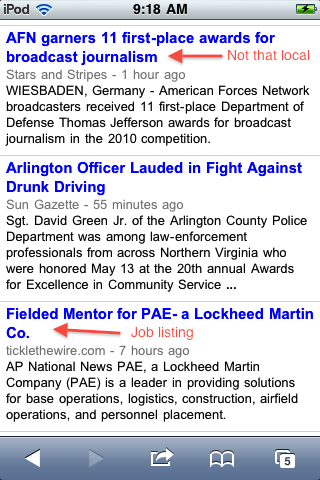
- Two of the top five “local” stories Google News served me were either not really local or not really a story.
To create a market-dominating filter of local news, someone will need to curate the pool of aggregated news to match each reader’s interests, browsing history and social network activity, in addition to his or her location.
The killer app would be one that filters a breadth of local aggregation like Outside.in through a hyperpersonalized social filter sought by mobile services such as News.me and Trove combined with the personal browsing and search history of Google.
And even with all that, it remains to be seen whether automated filtering can entirely replace the role of a human editor in subjective news judgment. A human news editor would know a job posting is not a local news story no matter how many times it mentions your city’s name.
There remains an opportunity for media companies to be the dominant source of news aggregation and curation in their local markets, if they leverage their human touch and institutional knowledge as an advantage over Google and catch up on some of the technological systems. But many news organizations will first have to conquer reflexive fears about linking out and sending readers to other sites.
Your opinions are welcome here. Can a news organization curate better than Google’s engineering-based system? Will Google’s algorithms eventually be better than a human editor? Or will both approaches co-exist? source
Friday, March 18, 2011
Google Concentrating on Mobile Payment Services
Anyone looking to confirm Google’s burgeoning interest in mobile payment systems should have a full plate of additional evidence this summer as the Internet search giant is reportedly pushing ahead with a trial run for a new mobile payment service at New York and San Francisco-based stores.
Bloomberg reported Tuesday morning that in four months the trial program Google is launching will enable shoppers to use their phones to ring up purchases in the aforementioned locations.
The company will pay for installation of thousands of special cash-register systems from VeriFone Systems Inc. (PAY) at merchant locations, said one of the people, who requested anonymity because Google’s plans haven’t been made public. The registers would accept payments from mobile phones equipped with so-called near-field-communication technology.
The news from Google follows Monday’s report that Apple is reportedly moving ahead with its fifth generation iPhone and not including NFC technology as originally anticipated. It’s a decision that could give more NFC-friendly mobile phone markers an upper hand in the burgeoning business of mobile payments, particularly Google’s Nexus S, which already sports NFC technology.
Speaking in Barcelona, Spain last month at the Mobile World Congress, Google’s chief executive officer Eric Schmidt said “NFC has been around for a long time but everything has just started to come together.” Schmidt reiterated his confidence that Google will successfully leverage the opportunities born of NFC despite current obstacles.
“My phone remembers I need new pants,” says Schmidt, “and it knows ahead of me are two stores–one offering the product at a 20 percent discount, the other offering a 30 percent discount. I enter the store with the bigger discount, the pants are ready, and out I go. You don’t think this is going to work? It should revolutionize electronic commerce and payments. We’re seeing that models around consumerism are working when they’re tied to location and advertising.”
According to Bloomberg, Google’s rumored venture in New York and San Francisco will further cement the company’s place within a “growing field of companies experimenting with NFC.”source
Sunday, March 13, 2011
Person Finder Service From Google For Japan
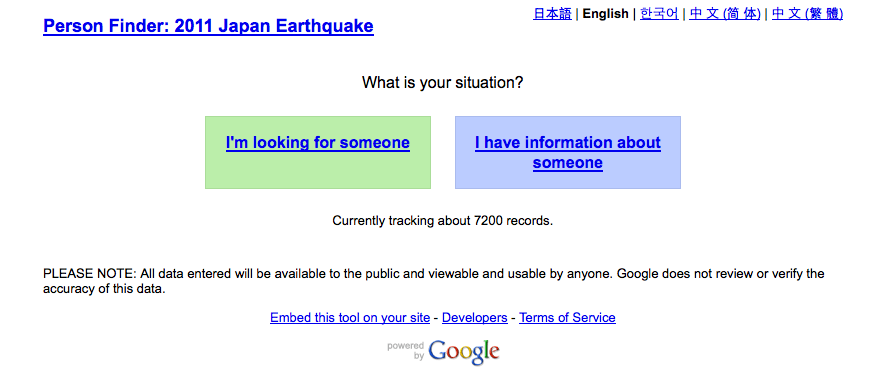
Google moved quickly to launch a service to help connect people missing in Japan with their loved ones.
In just under three hours after the 8.9 magnitude earthquake in Japan, Google had its Person Finder service up and running. The app lets people report someone as missing or report someone who has been found.
The website is setup in both a Japanese and English version and includes the warning: “All data entered will be available to the public and viewable and usable by anyone. Google does not review or verify the accuracy of this data.”
Within two hours of launching, the service had gained 2,000 entries from people reported missing, or from people who had been reported alive. As of 11:00 AM EST the service was tracking some 7,200 entries.
Google used a similar service following the recent earthquake in Christchurch, New Zealand and following last year’s quakes in Haiti and Chile.
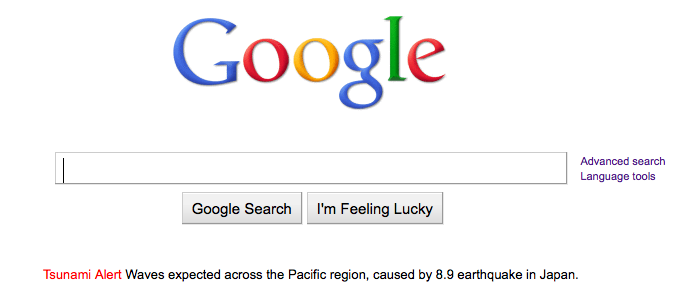
Google also posted a tsunami warning on its homepage, warning of danger in the Pacific region caused by the earthquake in Japan. Earlier in the morning the homepage contained a more direct warning: “Tsunami Alert for New Zealand, the Philippines, Indonesia, Papua New Guinea, Hawaii, and others. Waves expected over the next few hours, caused by 8.9 earthquake in Japan.” source
Monday, February 14, 2011
Swarm Of Google Services
This week NetSpeak takes a fresh look at some of the latest offerings from Google.
Google's dominance over the online world seems to be insurmountable. Aside the wide variety of search services from its flagship search product pack (web search, video search, blog search and the like), Google offers numerous other services as well (Google mail, Browser, Google Apps and the like). Even in the fastest growing mobile web segment, Google is surging ahead.
The on-line world is now agog with the news that Android, the open source mobile operating system from Google, has become a major platform for mobile devices (http://www.gpsbusinessnews.com/Canalys-Android-is-World-Leading-Smartphone-Platform_a2775. html).
The staggering number of mobile applications being released for Android-based smart-phones further underlines this trend. NetSpeak will deal on this topic in one of the forthcoming editions of this column.
An interesting feature of the Google's product ecosystem is that its constituents interact with mutual synergy, making it grow in an organic manner.
This aspect is quite apparent in Chrome, the popular browser from Google. As already mentioned in an earlier column, the strength and popularity of Chrome lies in the availability of a variety of extensions that enhance its power.
Extensions meant for accessing almost all Google services with ease are in place. You may also note that the latest version of Chrome has got a feature called ‘Instant', which is similar to Google Instant.
This feature enables the browser to load a web page as soon as one starts entering its URL. Besides this, instead of a site's URL, if you are entering a search string, search results will start appearing as you type.
Google Apps marketplace
Google Apps (http://www.google.com/apps/) is a significant component of Google ecosystem. For those of you who are not familiar with Google Apps, it is a Google service that provides various Google products (such as gmail and google docs) on a custom domain. Anyone with a domain name can avail of this service, which is free for up to 50 uses.
Google Apps allows a domain owner to leverage Google's infrastructure and deploy Google's popular applications on his domain without incurring any additional hardware/software overhead. Google also offers ‘Google Apps Marketplace', a web-based platform meant for finding/installing third-party on-line applications that work with Google Apps' built-in application mix.
The latest development in the ‘Apps Marketplace' front is the launch of a new channel exclusively meant for the education segment (http://goo.gl/pdGZJ). In this category one can find several applications useful for both teachers and students.
Brainpop, a popular on-line service that creates educational content for kids is a good example.
The service offers animated educational movies on a range of topics within Science, Technology, Social studies, English and so on. Although Brainpop is not a free service, for ‘Google Apps' users it is available for free till March 11, 2011.source
Sunday, February 13, 2011
Google Nexus S with AT&T 3G Appears at FCC
Google is one of the world’s leading software manufacturers both in terms of online applications and mobile software. Quite obviously, their Androidmobile platform can largely be attributed when it comes to their success as it has become one of the most used platforms in the world. However, Google has also dabbled in in the hardware world working closely with manufactures like HTC and Samsung to push out the Nexus One and Nexus S, respectively.
However, both the Nexus One and Nexus S currently only work with T-Mobile’s 3G speeds leaving those wanting to use it on AT&T with slow speeds. Luckily, a version of the Nexus S was just spotted at the FCC complete with AT&T 3G built-in. Unfortunately, this device has yet to be confirmed but seeing how the Nexus S is one of the most highly sought after Android devices currently on the market it most likely won’t be too long now.source
Saturday, February 5, 2011
Speak To Tweet Service By Google
 |
| Speak To Tweet Service By Google |
"Like many people we've been glued to the news unfolding in Egypt and thinking of what we could do to help people on the ground. Over the weekend we came up with the idea of a speak-to-tweet service-the ability for anyone to tweet using just a voice connection," wrote Ujjwal Singh, co-founder of SayNow and AbdelKarim Mardini, product manager, Google Middle East & North Africa.
Google worked with a small team of engineers from Twitter, Google and SayNow, a company it purchased last week, to create speak-to-tweet.
Google worked with a small team of engineers from Twitter, Google and SayNow, a company it purchased last week, to create speak-to-tweet.
"It's already live and anyone can tweet by simply leaving a voicemail on one of these international phone numbers (+16504194196 or +390662207294 or +97316199855) and the service will instantly tweet the message using the hashtag #egypt. No Internet connection is required. People can listen to the messages by dialing the same phone numbers or going to twitter.com/speak2tweet," the blog post said.
The phone numbers are being rapidly spread across Twitter as people learn about Google's speak-to-tweet.source
Sunday, January 30, 2011
Google Service Solves Sudoku By Looking At It.
If you're stuck on your sudoku puzzle, there's hope. New photo recognition software for Android mobiles, Goggles, can help solve the puzzle.
Just hold the numerical puzzle up to the camera on your mobile. Goggles will then recognize the numbers already in the puzzle and calculate the missing values.
Goggles, now in version 1.3, is also capable of reading ads in US magazines and newspapers and pulling up the appropriate websites. Recognition of bar codes has also gotten better, reported Google in its blog.
Goggles photographs items and loads them up to Google's servers, where they are analyzed before results are sent to the user's mobile.
Google says the app can also recognize products and famous sites. It also translates texts between English, German and Spanish.
The free software is available for all smart-phones that use the Android operating system. The Sudoku assistance is also available in the Google Mobile app for the iPhone.source
Just hold the numerical puzzle up to the camera on your mobile. Goggles will then recognize the numbers already in the puzzle and calculate the missing values.
Goggles, now in version 1.3, is also capable of reading ads in US magazines and newspapers and pulling up the appropriate websites. Recognition of bar codes has also gotten better, reported Google in its blog.
Goggles photographs items and loads them up to Google's servers, where they are analyzed before results are sent to the user's mobile.
Google says the app can also recognize products and famous sites. It also translates texts between English, German and Spanish.
The free software is available for all smart-phones that use the Android operating system. The Sudoku assistance is also available in the Google Mobile app for the iPhone.source
Monday, January 24, 2011
Google launches Cloud Print wireless printing service for Android, iOS (iPhone), HTML5-compatible devices

While we’re trying to go “all-digital” with our smartphones, and have physical print-outs become less important, Cloud Print is terribly convenient. Sometimes email just can’t do it all for you. Having the option to print a document while you are on your way to work and have it waiting for you when you get there may be a dream come true to many people, and giving mobile devices this option makes the service just that much more powerful.
Setting up the Cloud Print service is easy enough, and after you link the printer to your Gmail account, printing is only a couple clicks away. As you’d expect, when viewing an email, hitting the menu option on the mobile site (Gmail, Docs) will reveal the option to print the current document, or email, that you’re currently viewing. As it develops, we can expect to see more advanced printing options become available.
So whether or not you think you’ll ever use Cloud Print, if you use the Chrome browser, you might as well set it up. You never know when you may need it.
Wednesday, January 5, 2011
A Google Mobile Payment Service>>>
"You'll be able to walk in a store and do commerce," says Google's Eric Schmidt. "You'd bump for everything and eventually replace credit cards"
Google (GOOG) is considering building a payment and advertising service that would let users buy milk and bread by tapping or waving their mobile phones against a register at checkout, two people familiar with the plans say. The service may make its debut this year, say the two, who requested anonymity because the plans haven't been announced. It is based on near-field communication technology, which can beam and receive information wirelessly from 4 inches away.
Google joins a slew of companies that want in on the NFC market, which may account for a third of the $1.13 trillion in global mobile-payment transactions projected for 2014, according to IE Market Research. In November, Verizon Wireless, AT&T (T), and T-Mobile USA (DTEGY) formed a venture called Isis to offer an NFC-based service in 2012. Visa (V) is testing contactless payments and planning to roll them out commercially in mid-2011, says Bill Gajda, Visa's head of mobile innovation.
"It's a land grab," says Jaymee Johnson, a spokesman for Isis. "Folks are sort of jockeying for position." "
Open to Partnerships
EBay's (EBAY) PayPal may start a commercial NFC service in the second half of 2011, says Laura Chambers, senior director of PayPal Mobile. The system would also power peer-to-peer NFC transactions. For example, a restaurant patron might beam his share of the bill to his dining companion's phone. PayPal is open to partnering on NFC payments with companies such as Google, Chambers says.
Speaking about NFC at a technology conference in November, Google Chief Executive Eric Schmidt said, "You'll be able to walk in a store and do commerce. You'd bump for everything and eventually replace credit cards." Andy Rubin, Google's vice-president for engineering, declined to comment on future services and products.
A single NFC chip on a mobile phone would hold a consumer's financial account information, gift cards, store loyalty cards, and coupon subscriptions, say the people familiar with Google's plans. Users may also be able to make online purchases from their phones. By scanning a movie poster, for instance, a consumer might read reviews and use the Google service to purchase tickets.
"NFC could displace the cash register," says Charles Walton, chief operating officer for NFC chipmaker Inside Secure. "This is going to come superfast."
New Version of Android
Google may be in a good position to disrupt the payments industry because merchants and consumers already use its technology widely. Some 300,000 people activate phones daily that use its Android software. On Dec. 6, Google released its newest version of Android, called Gingerbread, which has some NFC features, such as reading information from NFC tags. More functionality "will come out pretty quickly," says Google's Rubin. On the market since Dec. 16, the NFC-enabled Nexus S phone, developed with Samsung Electronics, will serve as a test for a Google payment and ad service, says one of the people knowledgeable about Google.
Last year, Google bought Zetawire, a Canadian startup with a patent on a way to combine a phone-based wallet with a reward-and-loyalty system. Google Ventures, the company's venture capital arm, also invested in Corduro, a closely held developer of mobile-payment solutions in Southlake, Tex.
Google is ramping up efforts to seed merchants nationwide with NFC tags, which can be read by NFC-enabled phones. Since mid-December, it has handed out hundreds of NFC kits—including window tags and fortune cookies to give to customers—to businesses in Portland, Ore., where Google is testing a project called Hotpot.
What the Oregon Test Shows
When scanning an NFC-enabled window decal with an Android-based NFC phone, a user can see the business's work hours, check out reviews, rate the business, and get advice from Google on other local businesses. "It's something that helps local businesses," says Sara Heise, an event planner at Voodoo Doughnut, one of the businesses taking part in the Portland test. "It'll allow us to interact with our customers more, especially the younger, texting generation."
To promote the technology and local advertising, Google gave out 22,000 T-shirts at a Portland Trail Blazers basketball game. "We are going to start expanding into more and more cities in the near future," says Lior Ron, group product manager for Hotpot. "We want to make it national."
Global shipments of NFC phones will jump to 220.1 million units in 2014, up from 52.6 million in 2010, according to consultant ISuppli in El Segundo, Calif.
Last year, iPhone maker Apple (AAPL) hired Benjamin Vigier, an expert on NFC technology. The company also filed for a patent on a way to transmit payments from one cell phone to another using NFC. Apple spokeswoman Natalie Kerris didn't return a request for comment. Research In Motion (RIMM), which makes the BlackBerry, filed for a patent on a system that makes NFC payments more secure. RIM spokeswoman Marisa Conway didn't immediately return a request for comment.
An NFC payment and ad service may let Google grab a bigger piece of the U.S. mobile-ad business. The company ended 2010 with 59 percent of the $877 million market, according to an estimate by research firm IDC in Framingham, Mass. "Google is a very innovative company," says Johnson at Isis. "They'll continue to push the envelope and have a number of potential roles to play." :By Kharif
Subscribe to:
Posts (Atom)